
Stress, Cortisol, HPA, CRH, adrenals, immunoneurology ...
-
webslave

- Maintenance

- Posts: 11432
- Joined: Wed Oct 30, 2002 3:18 pm
- Location: Please give your location so we can help better
Re: Stress, Cortisol, HPA, CRH, adrenals, immunoneurology ...
No, I'm saying that the same pathways could be involved. Theoharides has a similar diagram for Chronic Fatigue Syndrome (CFS). I'll get that up here too in a bit. I had/have CFS (has now receded a lot) that started at the same time as my CPPS. This is common. Excessive fatigue, swollen/sore lymph glands etc are all symptoms of CFS, which a lot of guys who have chronic prostatitis / chronic pelvic pain syndrome also have.
Good News! The great ProstaQ is BACK at last! You must try it.
| HAS THIS SITE HELPED YOU? Say Thanks by donating. Keep the Forum alive on the Internet! PayPal link at end of page ↓ Contact me at support at ucpps.men |  |
-
webslave
- Maintenance
- Posts: 11432
- Joined: Wed Oct 30, 2002 3:18 pm
- Location: Please give your location so we can help better
Re: Stress, Cortisol, HPA, CRH, adrenals, immunoneurology ...
From another Theoharides paper: The Critical Role of Mast Cells in Allergy and Inflammation 2006
THEOHARIDES & KALOGEROMITROS: CRITICAL ROLE OF MAST CELLS wrote:Mast cell triggers
Antigen + IgE
Anaphylatoxins
CRH (corticotropin-releasing hormone)
IL-1 (interleukin-1)
Immunoglobulin-free light chains
LPS (lipopolysaccharide)
NGF (nerve growth factor)
NT (neurotensin)
SCF (stem cell factor)
SP (substance P)
Superantigens
Ucn (urocortin)
VIP (vasoactive intestinal peptide)
Viral DNA sequences
CONCLUSION
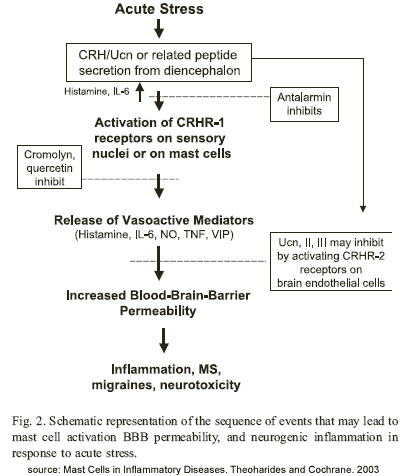
Mast cells have emerged as unique immune cells that can be activated by many immune and nonimmune triggers, including acute stress through CRH; it is, therefore, proposed that CRH be renamed SRH (Stress Response Hormone) to reflect its versatile role in stress. Mast cells are critical in the development of inflammatory diseases, especially dermatoses, asthma, arthritis, and CAD. Inhibition of mast cell activation by CRH, therefore, is a novel target for the development of new treatments for inflammatory and autoimmune disorders. Certain dietary supplements have recently been shown to be effective in this regard because they combine the proteoglycan chondroitin sulfate and the flavonoid quercetin, both of which have mast cell inhibitory and anti-inflammatory actions.
Good News! The great ProstaQ is BACK at last! You must try it.
| HAS THIS SITE HELPED YOU? Say Thanks by donating. Keep the Forum alive on the Internet! PayPal link at end of page ↓ Contact me at support at ucpps.men | |
-
webslave
- Maintenance
- Posts: 11432
- Joined: Wed Oct 30, 2002 3:18 pm
- Location: Please give your location so we can help better
Re: Stress, Cortisol, HPA, CRH, adrenals, immunoneurology ...
From Chronic Fatigue Syndrome, Mast Cells, and Tricyclic Antidepressants by Theoharis C. Theoharides, BS, MS, MPhil, PhD, MD
Journal of Clinical Psychopharmacology Volume 25, Number 6, December 2005

Journal of Clinical Psychopharmacology Volume 25, Number 6, December 2005
Good News! The great ProstaQ is BACK at last! You must try it.
| HAS THIS SITE HELPED YOU? Say Thanks by donating. Keep the Forum alive on the Internet! PayPal link at end of page ↓ Contact me at support at ucpps.men | |
-
webslave
- Maintenance
- Posts: 11432
- Joined: Wed Oct 30, 2002 3:18 pm
- Location: Please give your location so we can help better
Re: Stress, Cortisol, HPA, CRH, adrenals, immunoneurology ...
Concluding remarks from the same paper:
EFFECT OF AMITRIPTYLINE ON RAT MAST CELL SECRETION
Given the above, we hypothesized that the beneficial action of tricyclic antidepressant on CFS may be through inhibition of mast cell activation. Our preliminary results indicate that the tricyclic antidepressant, amitriptyline, can inhibit rat mast cell secretion and reduce intracellular calcium ion levels.... Pretreatment of mast cells with amitriptyline ... inhibited histamine release significantly in a dose-dependent manner ... These results indicate that amitriptyline somehow decreased the basal intracellular calcium concentration, making it difficult for mast cells to be subsequently activated.
Significance
The possible relationship of mast cells to behavioral states is suggested by the fact that brain mast cell activation can occur in response to isolation stress, to restraint stress, subordination stress, and during courtship after isolation of male doves. The potential pathophysiological role of brain mast cells triggered by acute stress has been reviewed.
We recently showed that mast cells could be unique targets of CRH and related peptides contributing to neurogenic inflammation. Tricyclic antidepressants may be beneficial in CFS because of their ability to inhibit brain mast cell activation and release of proinflammatory molecules. It will be interesting to see if this action is unique to tricyclics or can be exerted by other antidepressants. Other potentially useful mast cells inhibitors could be naturally occurring flavonoids, such as quercetin, found in certain unique dietary supplements.
Good News! The great ProstaQ is BACK at last! You must try it.
| HAS THIS SITE HELPED YOU? Say Thanks by donating. Keep the Forum alive on the Internet! PayPal link at end of page ↓ Contact me at support at ucpps.men | |
-
webslave
- Maintenance
- Posts: 11432
- Joined: Wed Oct 30, 2002 3:18 pm
- Location: Please give your location so we can help better
Re: Stress, Cortisol, HPA, CRH, adrenals, immunoneurology ...
Theoharides, 2007 wrote:CONCLUSION
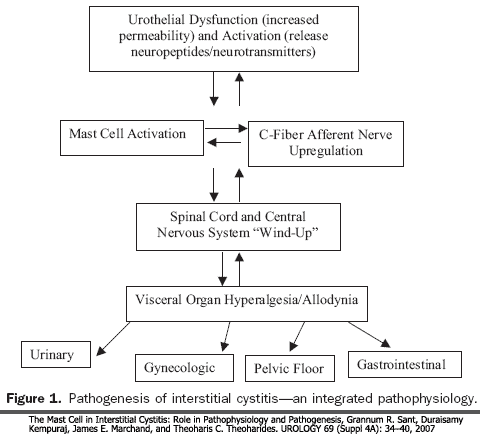
Current evidence (human and experimental) from electron microscopy and modern immunohistochemical staining techniques confirms a central role for mast cells in the pathogenesis and pathophysiology of IC. Identification of patient subgroups with IC and mast cell proliferation and activation will allow targeted pharmacotherapy with drugs that inhibit mast cell activation and mediator release. No clinically available compounds effectively block mast cell activation. Chondroitin sulfate and the flavonoid Quercetin both have synergistic action in inhibiting mast cells .... Mast cells may be activated by a number of mechanisms within the bladder wall. Increased urothelial permeability with influx of potassium ions may lead to sensory afferent nerve upregulation with stimulation of mast cell activation, which, in turn, could further activate the afferent nerves in a vicious circle. Recent evidence from humans and from animal models has shown that the urothelium can release a number of neuropeptides (eg, purinergic, NGF) and neurotransmitters that may activate submucosal afferent nerves and mast cells. These changes in urothelial permeability, urothelial activation, sensory nerve stimulation, and mast cell activation are complex and highly interrelated with multiple and simultaneous positive and negative feedback loops (Figure 1). This vicious circle contributes to the chronicity of voiding and pain symptoms of IC, as well as the complex neuroinflammatory and neuroimmunoendocrine changes in the bladder wall of patients with IC. Once the sensory nerves in the bladder are upregulated, neurons in the dorsal post ganglia and spinal cord also release tachykinins (including SP), leading to a state of neurologic "wind-up" manifested by visceral allodynia and hyperalgesia in the bladder and adjacent pelvic organs (gastrointestinal, gynecologic). This explains why many patients with IC have pelvic floor dysfunction, gynecologic symptoms such as dyspareunia and vulvodynia, and gastrointestinal conditions such as irritable bowel syndrome.
Good News! The great ProstaQ is BACK at last! You must try it.
| HAS THIS SITE HELPED YOU? Say Thanks by donating. Keep the Forum alive on the Internet! PayPal link at end of page ↓ Contact me at support at ucpps.men | |
-
webslave
- Maintenance
- Posts: 11432
- Joined: Wed Oct 30, 2002 3:18 pm
- Location: Please give your location so we can help better
Re: Stress, Cortisol, HPA, CRH, adrenals, immunoneurology ...
In a 2006 paper dealing with how mast cells in the skin are useful for looking at the stress -> CRH pathway, Theoharides et al writes
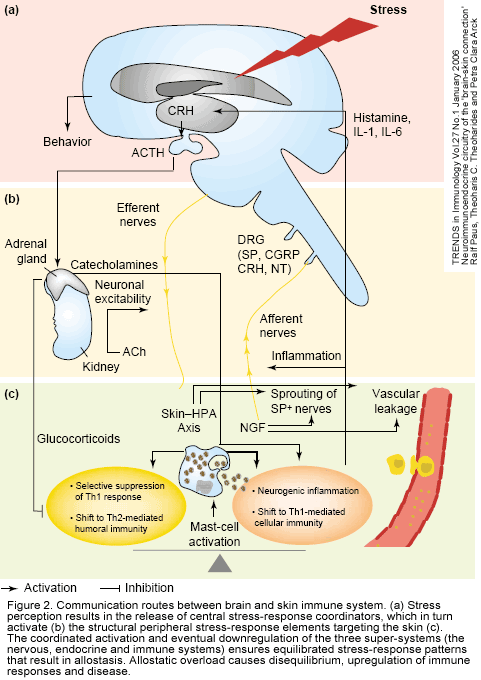
The skin offers an ideally suited, clinically relevant model for studying the crossroads between peripheral and systemic responses to stress. A 'brain–skin connection' with local neuroimmunoendocrine circuitry underlies the pathogenesis of allergic and inflammatory skin diseases, triggered or aggravated by stress. In stressed mice, corticotropin-releasing hormone, nerve growth factor, neurotensin, substance P and mast cells are recruited hierarchically to induce neurogenic skin inflammation, which inhibits hair growth. The hair follicle is both a target and a source for immunomodulatory stress mediators, and has an equivalent of the hypothalamus– pituitary–adrenal axis. Thus, the skin and its appendages enable the study of complex neuroimmunoendocrine responses that peripheral tissues launch upon stress exposure, as a basis for identifying new targets for therapeutic stress intervention
Good News! The great ProstaQ is BACK at last! You must try it.
| HAS THIS SITE HELPED YOU? Say Thanks by donating. Keep the Forum alive on the Internet! PayPal link at end of page ↓ Contact me at support at ucpps.men | |
-
webslave
- Maintenance
- Posts: 11432
- Joined: Wed Oct 30, 2002 3:18 pm
- Location: Please give your location so we can help better
Re: Stress, Cortisol, HPA, CRH, adrenals, immunoneurology ...
I have a few comments on these papers by Theoharides.
Firstly, most of them directly mention and promote his quercetin-containing products for the bladder and prostate, and there's nothing wrong with that. However, they compete with the Quercetin suppliers products, and yet Quercetin suppliers have research support for use in chronic prostatitis / chronic pelvic pain syndrome (not just IC), and Quercetin suppliers supports this forum (Theoharides's company, Algonot, does not).
Secondly, I have a basic disagreement with Theoharides, and that's about what causes UCPPS (IC and CPPS). His thesis is that it is the inflammation caused by the degranulated mast cells in the bladder/prostate epithelium, followed by wind-up and allodynia, that causes the pain of UCPPS. I say no, there's more. I say that the extent of the pain is too large for that to be the whole story, and investigation finds too many pain foci outside the bladder and prostate for the limited interaction between nerve and mast cells in the GU tract to all that is going on. Yes, the nerves are interacting with mast cells and making the bladder wall more permeable, allowing urine to irritate the bladder lining, and something very similar is doubtless happening in the prostatic urethra and ducts. But there is something even more important, or at least as important, happening in the pelvic floor muscles. It's the nerves + muscles that create the agony patients complain of, so bad that we can hardly walk (that's how bad I was, and many others too). If that part of the picture is ignored, the full story is not told.
Theoharides and the Stanford people need to link arms and come to a synthesis of their separate bodies of work. Both can fit into the same theory comfortably. Stress or trauma or infection or allergy or [insert trigger] leads to a CNS-level response that tends to inflame tissues. But the concomitant tensing of the pelvis in response to stress [and/or trauma or pain] creates trigger points in the pelvic floor, and through cross-talk and other neurological mechanisms, this feeds into the inflammation of the GU epithelial tissues. The two pathways dovetail and mutually reinforce. This is a highly complex topic, but it needs to be fully elucidated by the conjoining of people like Theoharides, Nickel, Shoskes, Anderson and Wise (because Wise is an expert on the psychogenesis of the condition).
Good News! The great ProstaQ is BACK at last! You must try it.
| HAS THIS SITE HELPED YOU? Say Thanks by donating. Keep the Forum alive on the Internet! PayPal link at end of page ↓ Contact me at support at ucpps.men | |
-
Rufus
- Senior Veteran

- Posts: 259
- Joined: Tue Oct 24, 2006 9:14 pm
Re: Stress, Cortisol, HPA, CRH, adrenals, immunoneurology ...
I don't think the good doctor was ruling out muscular dysfunction as a probable cause of CPPS.webslave wrote:This explains why many patients with IC have pelvic floor dysfunction, gynecologic symptoms such as dyspareunia and vulvodynia, and gastrointestinal conditions such as irritable bowel syndrome.
Age:37 | Onset Age: 35 | Symptoms: pain in testicles that comes and goes that also switches sides-trying to find a pattern as to "why" this happens/Rectal Burn at the 6 O'clock position at my anus which tends to flare around the periphery of my anus typically after defication but no perineum pain-no "golf ball" pain. Pain in testicles worsens as I sit but not always...Pain is not always present but depresses me. Pain used to be at a very high level but has subsided in time to a low level but has not gone away. Pain used to flare after sex but not as much as before although it still like playing russian roulette./
/Lack of SleepHelped By: I haven't found anything that has helped to my knowledge. Tried many many sessions of PT, accupuncture and chiropractic care but still have not found steady relief that takes me back to a pre CPPS state.
/Lack of SleepHelped By: I haven't found anything that has helped to my knowledge. Tried many many sessions of PT, accupuncture and chiropractic care but still have not found steady relief that takes me back to a pre CPPS state.
-
webslave
- Maintenance
- Posts: 11432
- Joined: Wed Oct 30, 2002 3:18 pm
- Location: Please give your location so we can help better
Re: Stress, Cortisol, HPA, CRH, adrenals, immunoneurology ...
Yes, I saw that too, and I see it as a hopeful sign that more rapprochement is possible between all side. 
Good News! The great ProstaQ is BACK at last! You must try it.
| HAS THIS SITE HELPED YOU? Say Thanks by donating. Keep the Forum alive on the Internet! PayPal link at end of page ↓ Contact me at support at ucpps.men | |
-
webslave
- Maintenance
- Posts: 11432
- Joined: Wed Oct 30, 2002 3:18 pm
- Location: Please give your location so we can help better
Re: Stress, Cortisol, HPA, CRH, adrenals, immunoneurology ...
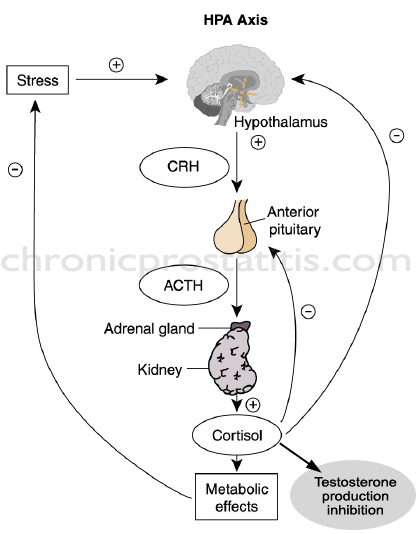
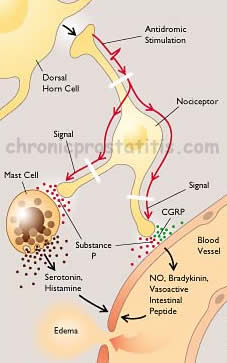
Just for completeness and to put all the relevant graphics into this thread:
Good News! The great ProstaQ is BACK at last! You must try it.
| HAS THIS SITE HELPED YOU? Say Thanks by donating. Keep the Forum alive on the Internet! PayPal link at end of page ↓ Contact me at support at ucpps.men | |
-
Rufus
- Senior Veteran
- Posts: 259
- Joined: Tue Oct 24, 2006 9:14 pm
Re: Stress, Cortisol, HPA, CRH, adrenals, immunoneurology ...
So if chronic prostatitis / chronic pelvic pain syndrome is a result of HPA axis dysfunction what is the solution?
Age:37 | Onset Age: 35 | Symptoms: pain in testicles that comes and goes that also switches sides-trying to find a pattern as to "why" this happens/Rectal Burn at the 6 O'clock position at my anus which tends to flare around the periphery of my anus typically after defication but no perineum pain-no "golf ball" pain. Pain in testicles worsens as I sit but not always...Pain is not always present but depresses me. Pain used to be at a very high level but has subsided in time to a low level but has not gone away. Pain used to flare after sex but not as much as before although it still like playing russian roulette./
/Lack of SleepHelped By: I haven't found anything that has helped to my knowledge. Tried many many sessions of PT, accupuncture and chiropractic care but still have not found steady relief that takes me back to a pre CPPS state.
/Lack of SleepHelped By: I haven't found anything that has helped to my knowledge. Tried many many sessions of PT, accupuncture and chiropractic care but still have not found steady relief that takes me back to a pre CPPS state.
-
webslave
- Maintenance
- Posts: 11432
- Joined: Wed Oct 30, 2002 3:18 pm
- Location: Please give your location so we can help better
Re: Stress, Cortisol, HPA, CRH, adrenals, immunoneurology ...
Ask what is causing the HPA-axis dysfunction. Clearly, one of the causes is psychological stress.
Good News! The great ProstaQ is BACK at last! You must try it.
| HAS THIS SITE HELPED YOU? Say Thanks by donating. Keep the Forum alive on the Internet! PayPal link at end of page ↓ Contact me at support at ucpps.men | |
-
mbaker
- Experienced

- Posts: 148
- Joined: Fri Mar 23, 2007 3:46 pm
- Location: Washington DC area
Re: Stress, Cortisol, HPA, CRH, adrenals, immunoneurology ...
Probably why the SP focus on moment-to-moment relaxation, and following a regular meditation practice is part of the treatment.
--mb
--mb
Age: 45; Onset: Jan 2007; Initial | Symptoms: perineal, pubic, penile, right testicle pain, pain while sitting; Current | Symptoms: 95% better; very seldom do I have pain now; caffeine was the culprit; Helps: No caffeine (even decaf), Red tea, Getting exercise, Pure Encapsulations Nutrient 950 multi-vitamin; Hurts: Caffeine, sometimes when my l5s1 back issue acts up.
-
S0b0T
- New Member

- Posts: 14
- Joined: Sun Feb 01, 2009 1:26 am
Re: Stress, Cortisol, HPA, CRH, adrenals, immunoneurology ...
George P. Chrousos that developed one of those papers is my professor and the doctor that is following me for a virus related condition, a serious finasteride-induced gonadotrophin problem and a series of overtraining symptoms that led me to am HPA dysfunction and chronic fatigue syndrome.
My case of prostatitis and pelvic related symptoms started after I used finasteride and I get flare ups every time I hamper with my neurotransmitters, hormones and so on or develop some major stress issue or even drink coffee nowadays. HPA axis integrity plays major roles in your pelvic problems that's for sure.
I can attest to this by showing you all my hormonal levels years before fin use and after it, and also after I took Cipro which is a known endocrine disruptor.
Changes in HPA axis and stress system in general with lowering of testo levels and /or decreasing your cortisol estrogen receptor sensitivities, gene mRNAs or free available levels can bring havoc to your prostate and not only, but also cause significant and serious problems even of cancerous manifestations and this is not catastrophizing, I have seen it happen in hospitals years on and on.