The theory of pelvic floor trigger points and pelvic myoneuropathy can still be enlarged and made richer by fully teasing out the immunoneurological aspects, specifically those dealing with hormones, the adrenal glands, mast cells, nerves, and various cytokines.
I do not have the time to master all the concepts fully, so if someone here has training in the area, feel free to comment.
I'm going to dump my current thoughts, areas of interest and quotes here for you to mull over. Some may be pertinent, some not.
Key
ACTH: Adrenocorticotropic hormone
CNS: Central nervous system
CRH: Corticotropin-releasing hormone
HPA: Hypothalamic-pituitary-adrenal (axis)
SNS: Sympathetic nervous system
----------------------
Dr Anderson on cortisol
viewtopic.php?f=34&t=4662
----------------------
Our page on stress
https://ucpps.men/stress-and-chronic-prostatitis-CPPS
----------------------
Landmark Chrousos paper (PMID 11080744)
full text here
Journal of Allergy and Clinical Immunology Volume 106 o Number 5 o November 2000 Mosby, Inc. Stress, chronic inflammation, and emotional and physical well-being: Concurrent effects and chronic sequelae. George P. Chrousos MD
Mentions the "CNS, which, through a complex CRH-dependent pathway triggers the activation of both the HPA axis and the SNS"
The HPA axis (hypothalamic-pituitary-adrenal axis) and the SNS are peripheral limbs of the stress system
CRH, however, is also secreted peripherally at inflammatory sites (peripheral or immune CRH) and influences the immune system directly through local modulatory actions
CRH activates mast cells, which leads to the release of histamine and other contents of the mast-cell granules that subsequently cause vasodilation, increased vascular permeability, and other manifestations of inflammation
Chrousos talks about "Neuro-mast-cell connections".
Cortisol levels during the day: "Several circadian immune functions cause disease-associated diurnal changes that correspond to plasma glucocorticoid levels.[2] For example, the delayed hypersensitivity reaction, which is particularly sensitive to glucocorticoids, is greatest in the evening when glucocorticoids are low and least in the morning when they are high. The same is true for the cytokine IL-6, whose levels in plasma have a circadian rhythm, with peaks in the evening and early morning hours."
Self-reinforcing Feedback: "..nociceptive, visceral, and somatosensory afferent neurons of the peripheral nervous system from inflammatory sites acutely stimulate the noradrenergic and CRH stress systems through an ascending neural spinal or cerebral nerve route."
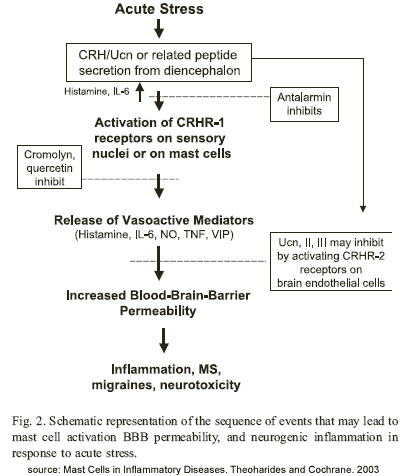
Stress and Sickness Syndrome: Certain cytokines, particularly the proinflammatory ones (eg, TNF-alpha, IL-1, and IL-6), activate both the HPA axis and the LC-NE/SNS system (ie, the key components of the classic stress response). [2] [11] Moreover, these cytokines induce anorexia/nausea, fatigue, social withdrawal and/or depressive affect, hyperalgesia with or without headache, somnolence, sleep disturbances, temperature elevation or fever, and increases of the basal metabolic rate, adaptive changes collectively referred to as "sickness syndrome." These cytokines also activate the hepatic and other tissue synthesis of acute-phase proteins (such as C-reactive protein, cell-adhesion molecules, fibrinogen, and plasminogen activator inhibitor-1, another adaptive phenomenon referred to as the "acute phase reaction"). Stress that is associated with an immune challenge has been called "immune stress" or "inflammatory stress," which is a combination of the sickness and classic stress syndromes, along with their effects on the pain/afferent neural systems and the acute phase reaction
"...severe stress, as reported by many patients, often precedes the development of certain TH 1-mediated autoimmune states..."
The chronic pain and fatigue syndromes: Several chronic pain and fatigue syndromes (such as fibromyalgia and chronic fatigue syndrome) have been associated with chronic sickness syndrome manifestations (such as fatigue and hyperalgesia) and with hypoactivity of the stress system (Table III).[2] [19] Interestingly, these clinical manifestations and the hypocortisolism of these patients are quite reminiscent of mild glucocorticoid deficiency (Addison's disease). Patients with glucocorticoid deficiency have elevated levels of proinflammatory cytokines such as IL-6, which may explain their typical sickness syndrome manifestations.[11] [20] When we administered human recombinant IL-6 to these patients, we induced an explosive sickness syndrome that was markedly more severe than that observed in healthy control subjects. In contrast, patients with endogenous hypercortisolism showed very little or no response to IL-6 (unpublished observation).[5] It is tempting to speculate that patients with chronic pain and fatigue syndrome have an imbalance between the immune and inflammatory reactions and the stress response, which results in excessive sickness syndrome manifestations of the former versus the antithetical effects of the latter (Table II).
==========================
Theoharides on fibromyalgia
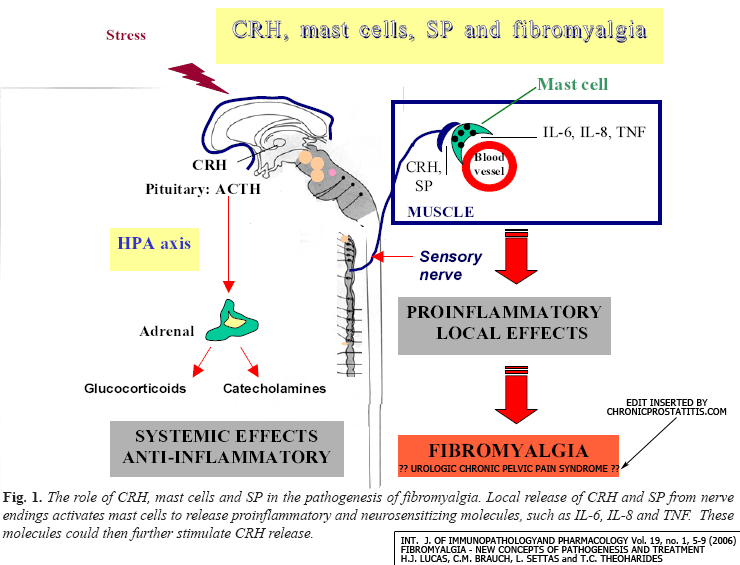
Pathogenesis is still unknown, but there has been evidence of increased corticotropin-releasing hormone
(CRH) and substance P (SP) in the CSF of FMS patients, as well as increased SP,
IL-6 and IL-8 in their serum. Increased numbers of activated mast cells were also
noted in skin biopsies. The hypothesis is put forward that FMS is a
neuro-immunoendocrine disorder where increased release of CRH and SP from neurons
in specific muscle sites triggers local mast cells to release proinflammatory and
neurosensitizing molecules. There is no curative treatment although low doses of
tricyclic antidepressants and the serotonin-3 receptor antagonist tropisetron,
are helpful. Recent nutraceutical formulations containing the natural
anti-inflammatory and mast cell inhibitory flavonoid quercetin hold promise since
they can be used together with other treatment modalities.
==============================
Cortisol, Stress (bullying), hypocortisolism, chronic pelvic pain
Key finding showing adrenals (make cortisol) are exhausted by chronic stress:
http://www.medicalnewstoday.com/articles/71124.php
(note : cortisol = body's own "cortisone" - anti-inflammatory)
PubMed citations
Chronic stress associated with hyposecretion of cortisol (hypocortisolism)
Low cortisol levels have been observed in patients with different stress-related disorders such as chronic fatigue syndrome, fibromyalgia, and post-traumatic stress disorder.
Cats with IC have low cortisol responses from their adrenal glands, and decreased adrenal gland size has been observed in patients with chronic fatigue syndrome, which can be a co-morbid condition in some patients with IC.
===============================
Unpublished findings by Nickel et al
Chronic pelvic pain syndrome patients show evidence of allostatic overload
Jaeseop Lee, Boston, MA; J. Curtis Nickel, Joe Downey, Kingston, ONCanada; Michael R Freeman, Jordan D Dimitrakov*, Boston, MA
Some researchers have theorized that painful bladder syndrome/interstitial cystitis PBS/IC is more than a pelvic problem that has a foundation in abnormalities of the neuroendocrine system, specifically in the hypothalamic-pituitary-adrenocortical (HPA) axis. That brain-pituitary gland-adrenal gland feedback system is responsible for the “fight or flight” reactions in response to stress. When adrenal gland hormones don’t put the brakes on the feedback system, the result is called “allostatic overload.” Now, a new study implies the HPA axis may also be dysfunctional in men with CP/CPPS. In the urine and expressed prostatic fluid of men with CP/CPPS, these researchers measured levels of markers thought to indicate allostatic overload. Those markers included corticotropin releasing hormone (CRH), neuropeptide Y (NPY), dehydroepiandrosterone (DHEA), epidermal growth factor (EGF), and galanin. (CRH, released from the hypothalamus, stimulates the pituitary gland to release corticotropin, which in turn stimulates the adrenal gland to release various hormones, including cortisol, which “puts the brakes” on the system, and sex steroids, such as DHEA, which is a precursor of estrogen and testosterone. NPY and galanin are nervous system transmitters. EGF is a growth factor that is elevated in IC patients’ urine.) NPY and galanin levels were significantly lower and CRH and DHEA levels were significantly higher in CP/CPPS patients than in healthy men. The investigators developed a score for allostatic overload based on the medical literature about these markers and found scores to be high in men with CP/CPPS. Therapies to treat CP/CPPS could be targeted at this system.
My Notes: Sustained morning cortisol elevations are indicative of allostatic overload.
PubMed citations
Protective and damaging effects of stress mediators: central role of the brain.
The concept of allostasis and allostatic load: psychoneuroimmunological findings