


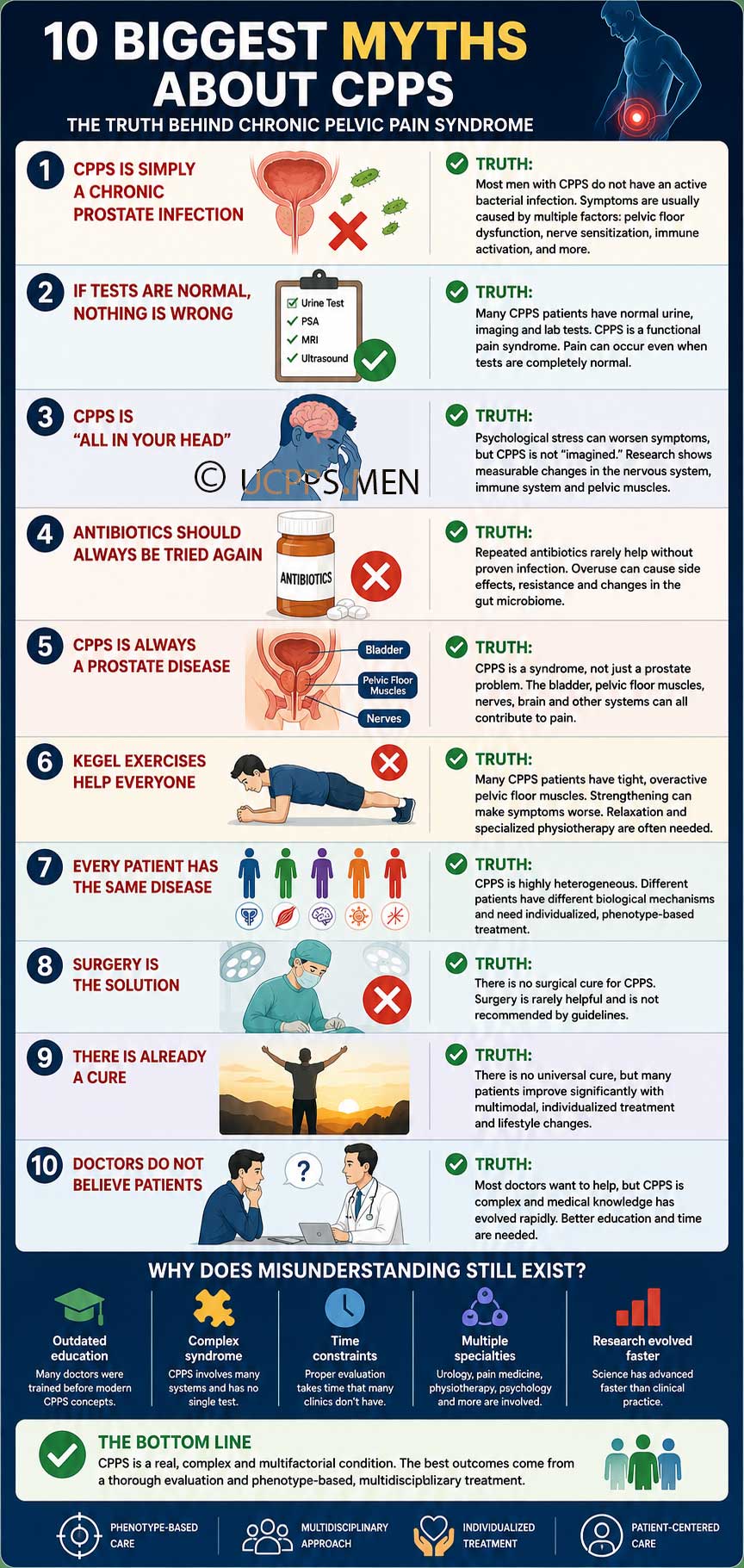
The 10 Biggest Myths About Chronic Pelvic Pain Syndrome (CPPS): Why Is This Condition Still So Poorly Understood?
Introduction
Despite decades of research, Chronic Prostatitis/Chronic Pelvic Pain Syndrome (CP/CPPS) remains one of the least understood conditions in urology. Modern AUA and EAU guidelines describe CPPS as a multifactorial chronic pain syndrome involving interactions between the urinary tract, pelvic floor muscles, nervous system, immune system and psychosocial factors. Nevertheless, outdated beliefs continue to influence diagnosis and treatment.
Myth 1: CPPS Is Simply a Chronic Prostate Infection
Most patients do not have an active bacterial infection. Repeated urine cultures are usually negative, and repeated antibiotics rarely provide lasting benefit without documented infection.
Myth 2: If Tests Are Normal, Nothing Is Wrong
Normal MRI, ultrasound or urine tests do not exclude chronic pain mechanisms. Functional disorders often produce severe symptoms without structural abnormalities.
Myth 3: CPPS Is "All in Your Head"
Psychological stress influences symptoms, but CPPS is associated with measurable biological changes including pelvic floor dysfunction, neuroimmune activation and central sensitization.
Myth 4: Antibiotics Should Always Be Tried Again
Repeated empiric antibiotic therapy is generally discouraged in patients without evidence of bacterial prostatitis.
Myth 5: CPPS Is Always a Prostate Disease
Pain may originate from pelvic floor muscles, sensory nerves, bladder hypersensitivity or central nervous system mechanisms.
Myth 6: Kegel Exercises Help Everyone
Many patients have overactive pelvic floor muscles, where relaxation—not strengthening—is the appropriate therapy.
Myth 7: Every Patient Has the Same Disease
CPPS consists of multiple phenotypes requiring individualized treatment.
Myth 8: Surgery Is the Solution
There is no standard surgical cure for typical CP/CPPS.
Myth 9: There Is Already a Cure
Many patients improve substantially, but no universal cure currently exists.
Myth 10: Doctors Do Not Believe Patients
Most physicians want to help, but CPPS remains a complex condition and knowledge has evolved rapidly.
Why Does Misunderstanding Still Exist?
- The term "chronic prostatitis" is misleading and suggests persistent infection.
- Medical education evolves gradually, and many clinicians trained before modern phenotype-based concepts became widespread.
- CPPS has no single laboratory test, imaging finding or validated biomarker.
- Research on neuroimmune mechanisms, pelvic floor dysfunction and central sensitization has advanced faster than routine clinical practice.
- Comprehensive CPPS evaluation requires time and often collaboration between multiple specialties.
- The condition spans urology, pain medicine, physiotherapy, neurology, psychology and immunology.
Current evidence supports phenotype-based, multidisciplinary management that integrates pelvic floor assessment, pain neuroscience, psychosocial care and individualized treatment strategies.
Key Take-Home Messages
✓ CPPS is not simply a chronic prostate infection.
✓ Normal investigations do not exclude genuine chronic pain mechanisms.
✓ Pelvic floor dysfunction and central sensitization are major contributors in many patients.
✓ Phenotype-based multidisciplinary care has the strongest scientific support.
✓ Implementation of modern evidence into everyday practice is still ongoing.
References
American Urological Association (AUA): Male Chronic Pelvic Pain Guideline (2025)
https://www.auanet.org/guidelines-and-q ... elvic-pain
European Association of Urology (EAU): Guidelines on Chronic Pelvic Pain
https://uroweb.org/guidelines/chronic-pelvic-pain
Bryk DJ, Shoskes DA. Using the UPOINT System to Manage Men with CP/CPPS.
https://pubmed.ncbi.nlm.nih.gov/34532167/
Nickel JC, Shoskes D, Wagenlehner FME. Management of Chronic Prostatitis/Chronic Pelvic
Pain Syndrome.
https://pubmed.ncbi.nlm.nih.gov/35688429/
NIH StatPearls: Chronic Prostatitis and Chronic Pelvic Pain Syndrome.
https://www.ncbi.nlm.nih.gov/books/NBK599550/
