I had been (and am still) taking 20 mg of Lexapro per day. I just started taking quercetin, two tablets per day. I was just reading that quercetin is "a potent inhibitor of CYP3A4 and CYP2C9," "enzymes that break down most drugs in the body."
https://en.wikipedia.org/wiki/Quercetin
One of the drugs it breaks down are the SSRIs. http://en.wikipedia.org/wiki/CYP3A4. It seems that quercetin has the same effect as grapefruit juice.
So, is it dangerous to take quercetin with an SSRI? What will likely or could happen? Do other people take Q with SSRIs? What has been your experience?
Quercetin and SSRIs
-
asg123
- New Member

- Posts: 13
- Joined: Mon Oct 05, 2009 6:38 pm
Quercetin and SSRIs
Age: | Onset Age: | Symptoms: | Helped By: | Worsened By: | Other comments:
-
webslave

- Maintenance

- Posts: 11432
- Joined: Wed Oct 30, 2002 3:18 pm
- Location: Please give your location so we can help better
Re: Quercetin and SSRIs
Interesting question. I cannot find research on quercetin-SSRI interaction.
But I did come upon this interesting study, that concludes
Then I found this fascinating study about fibromyalgia (a condition with many similarities to UCPPS):
But I did come upon this interesting study, that concludes
[T]hese results indicate that quercetin produces dose-related anti-nociception in several models of chemical pain, through mechanisms that involve interaction with L-arginine-nitric oxide, serotonin, and GABAergic systems. These results confirm and extend other investigations on the analgesic [pain suppressing] effect of quercetin and its mechanisms of action.
Then I found this fascinating study about fibromyalgia (a condition with many similarities to UCPPS):
Int J Immunopathol Pharmacol. 2006 Jan-Mar;19(1):5-10.
Fibromyalgia--new concepts of pathogenesis and treatment.
Lucas HJ, Brauch CM, Settas L, Theoharides TC.
Special Clinic for FMS and CFS, Trier, Germany.
Abstract
Fibromyalgia (FMS) is a debilitating disorder characterized by chronic diffuse muscle pain, fatigue, sleep disturbance, depression and skin sensitivity. There are no genetic or biochemical markers and patients often present with other comorbid diseases, such as migraines, interstitial cystitis and irritable bowel syndrome. Diagnosis includes the presence of 11/18 trigger points, but many patients with early symptoms might not fit this definition. Pathogenesis is still unknown, but there has been evidence of increased corticotropin-releasing hormone (CRH) and substance P (SP) in the CSF of FMS patients, as well as increased SP, IL-6 and IL-8 in their serum. Increased numbers of activated mast cells were also noted in skin biopsies. The hypothesis is put forward that FMS is a neuro-immunoendocrine disorder where increased release of CRH and SP from neurons in specific muscle sites triggers local mast cells to release proinflammatory and neurosensitizing molecules. There is no curative treatment although low doses of tricyclic antidepressants and the serotonin-3 receptor antagonist tropisetron, are helpful. Recent nutraceutical formulations containing the natural anti-inflammatory and mast cell inhibitory flavonoid quercetin hold promise since they can be used together with other treatment modalities.
PMID: 16569342 [PubMed - indexed for MEDLINE]
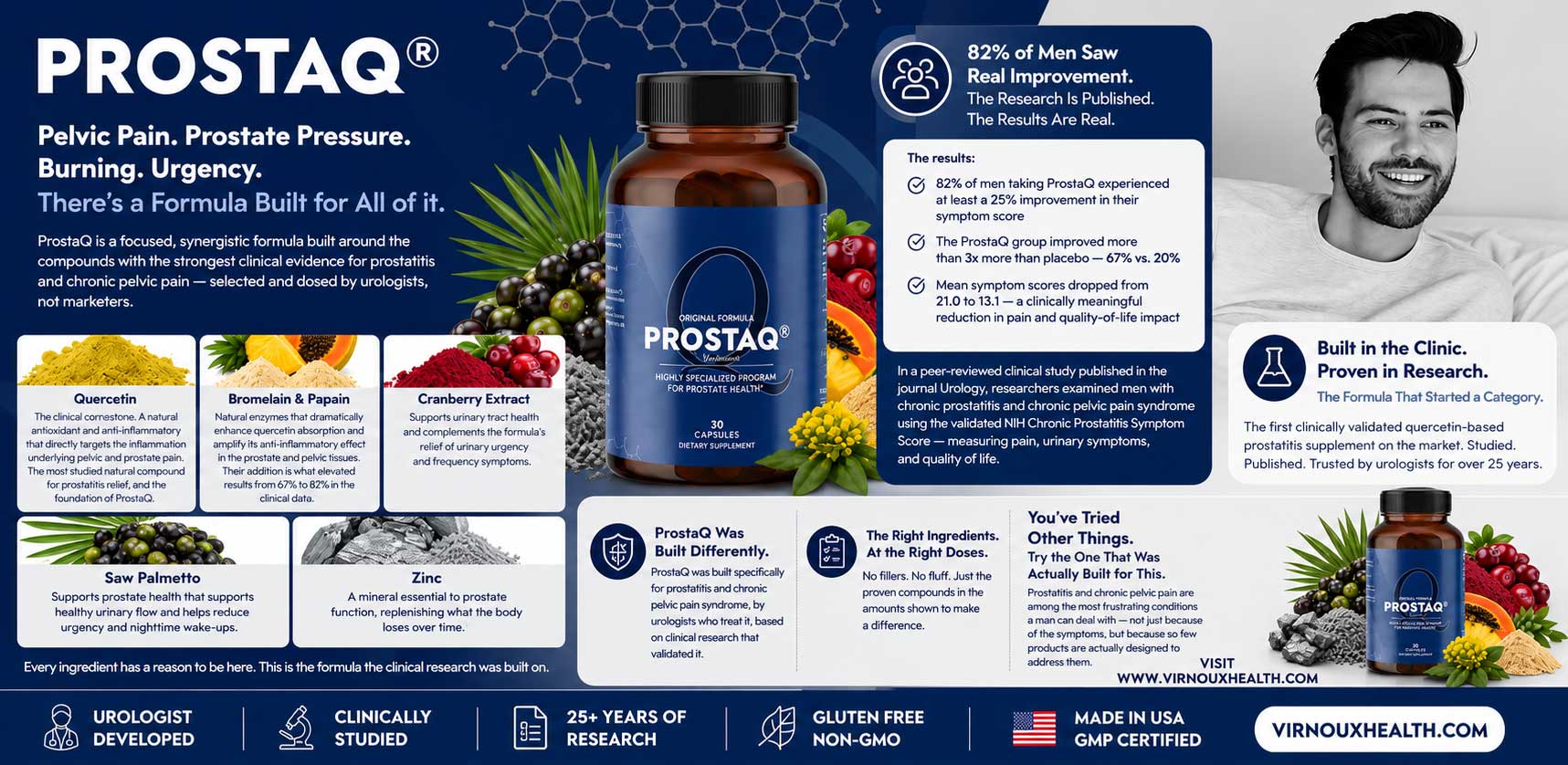
Good News! The great ProstaQ is BACK at last! You must try it.
| HAS THIS SITE HELPED YOU? Say Thanks by donating. Keep the Forum alive on the Internet! PayPal link at end of page ↓ Contact me at support at ucpps.men |  |