I went to the health clinic today and my BP was 140/80 for the fifth time in a row. Keep in mind, I'm a relatively fit 24 year old guy who doesn't smoke or eat a lot of junk (at least not anymore!).
This has been an issue I've been told to keep an eye on for a while, though none of my doctors have prescribed anything or pursued the matter further. Lately I've been getting mildly annoying pressure headaches between the eyes and I've been sweating a considerable amount even though the weather is cooling off, which I just read are classic symptoms.
I don't know if my high blood pressure contributed to my pelvic floor dysfunction or vice versa, but has anyone taken high blood pressure medication and noticed a difference in your symptoms? Those meds are almost definitely in my future since my BP has been consistently high.
High Blood Pressure Related to Pelvic Pain?
-
Caiaphas
- Beginner

- Posts: 34
- Joined: Sun Jun 22, 2008 5:30 pm
High Blood Pressure Related to Pelvic Pain?
Age: 25 | Onset Age: 21 | Symptoms: Ache in pubic region, lower back, and perineum; sore testicles, sore penis, occasional burning with urination, occasional soreness after ejaculation, reduced urinary flow, post void dribbling
Helped By: warm sitz baths, trigger point physical therapy, stretching, exercising
Worsened By: Stress and unknown factors
Current regimen/supplementation:One-A-Day Multivitamin, Pollen-Aid (2-3 a day), Quercetin (2 tabs a day), trigger point physical therapy once every 5-7 days, relaxing and stretching at night or when necessary.
-
webslave

- Maintenance

- Posts: 11432
- Joined: Wed Oct 30, 2002 3:18 pm
- Location: Please give your location so we can help better
Re: High Blood Pressure Related to Pelvic Pain?
High blood pressure can be caused in a fit young person by stress. You need to be completely relaxed when it is taken.
Does anyone in your immediate family have high blood pressure?
Does anyone in your immediate family have high blood pressure?
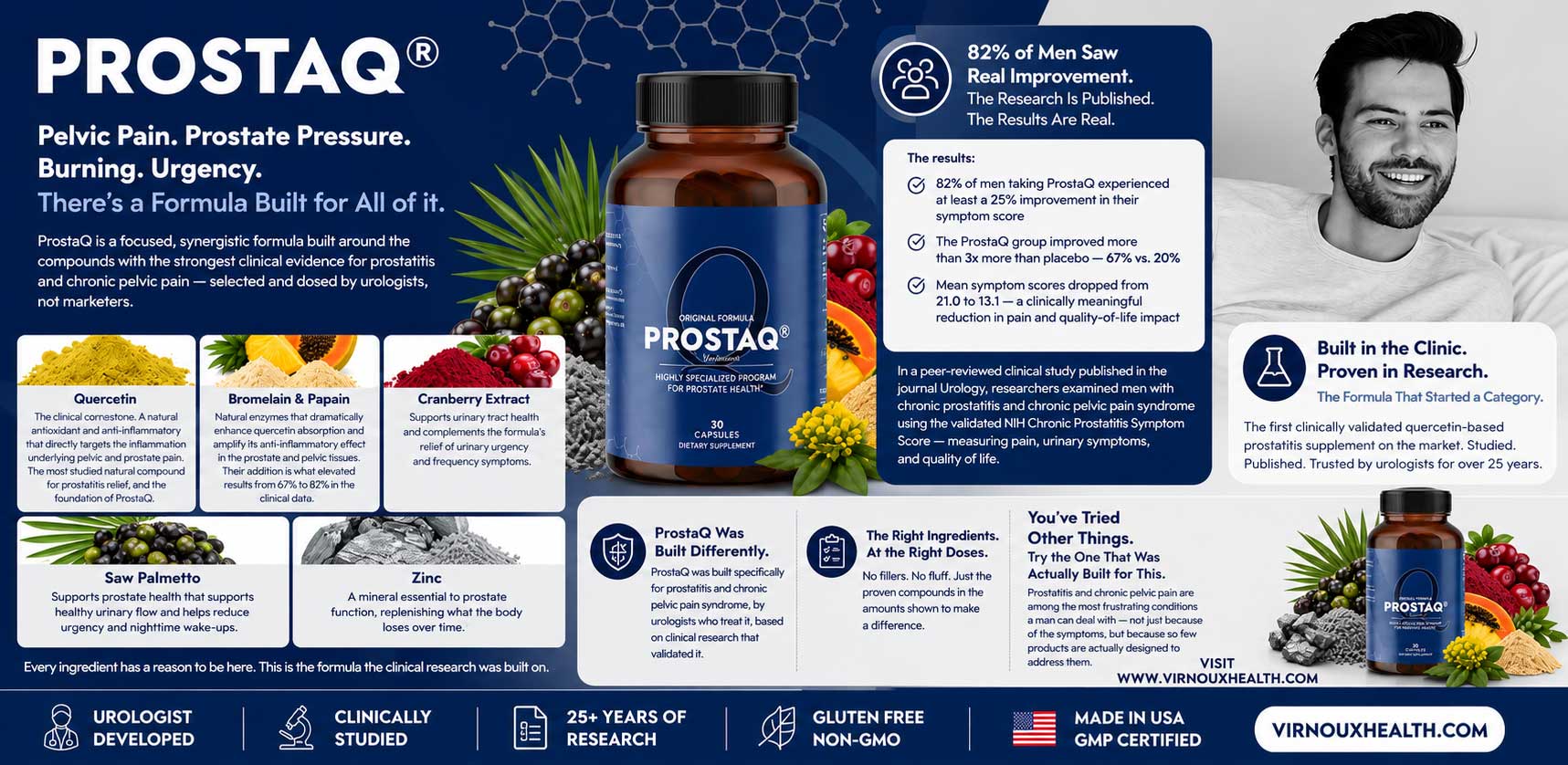
Good News! The great ProstaQ is BACK at last! You must try it.
| HAS THIS SITE HELPED YOU? Say Thanks by donating. Keep the Forum alive on the Internet! PayPal link at end of page ↓ Contact me at support at ucpps.men |  |
-
Caiaphas
- Beginner
- Posts: 34
- Joined: Sun Jun 22, 2008 5:30 pm
Re: High Blood Pressure Related to Pelvic Pain?
Yes, my Dad.
I was nervous during previous doctor appointments because I thought for sure I was going to have to get a cystoscopy, which scared the hell out of me.
The last few times it was taken, I want to say I was pretty relaxed. I'm not an overly stressed or anxious individual, so the high BP for so long is pretty surprising.
Age: 25 | Onset Age: 21 | Symptoms: Ache in pubic region, lower back, and perineum; sore testicles, sore penis, occasional burning with urination, occasional soreness after ejaculation, reduced urinary flow, post void dribbling
Helped By: warm sitz baths, trigger point physical therapy, stretching, exercising
Worsened By: Stress and unknown factors
Current regimen/supplementation:One-A-Day Multivitamin, Pollen-Aid (2-3 a day), Quercetin (2 tabs a day), trigger point physical therapy once every 5-7 days, relaxing and stretching at night or when necessary.
Helped By: warm sitz baths, trigger point physical therapy, stretching, exercising
Worsened By: Stress and unknown factors
Current regimen/supplementation:One-A-Day Multivitamin, Pollen-Aid (2-3 a day), Quercetin (2 tabs a day), trigger point physical therapy once every 5-7 days, relaxing and stretching at night or when necessary.
-
webslave
- Maintenance
- Posts: 11432
- Joined: Wed Oct 30, 2002 3:18 pm
- Location: Please give your location so we can help better
Re: High Blood Pressure Related to Pelvic Pain?
If it's in your family then it could be genetic, in which case you'll have to take measures and medications to combat it. It's not linked to CPPS.
Good News! The great ProstaQ is BACK at last! You must try it.
| HAS THIS SITE HELPED YOU? Say Thanks by donating. Keep the Forum alive on the Internet! PayPal link at end of page ↓ Contact me at support at ucpps.men | |
-
J Dimitrakov

- Urologist

- Posts: 326
- Joined: Wed Oct 30, 2002 4:59 pm
- Location: Boston, MA
Re: High Blood Pressure Related to Pelvic Pain?
We noted an association between high blood pressure and chronic prostatitis / chronic pelvic pain syndrome in our February 2008 paper on adrenocortical dysfunction and chronic prostatitis / chronic pelvic pain syndrome symptoms.
The same association was reported by Pontari et al in the NIH CPCRN cohort (Pontari et al, A case-control study of risk factors in men with chronic pelvic pain syndrome BJU Int. 2005 Sep;96(4):559-65.) who reported that "compared to controls, men with CP/CPPS reported a significantly greater lifetime prevalence of cardiovascular disease (11% vs 2%, P = 0.004)".
Another interesting point, at least in my own practice, is the association between carnitine intake (mainly in body-builders), chronic prostatitis / chronic pelvic pain syndrome and high blood pressure. The significance of this observation is yet unknown but is intriguing.
Finally, von Moltke LL et al. reported that some components of ginkgo, namely flavonol aglycones, and the biflavonoid amentoflavone, do inhibit CYP1A2 and CYP3A4. We have previously implicated an abnormal sympathetic response in a variety of chronic prostatitis / chronic pelvic pain syndrome symptoms ( von Moltke LL et al. Inhibition of human cytochromes P450 by components of Ginkgo biloba. J Pharm Pharmacol 2004 Aug;56(8):1039-44.)
Interestingly, ginkgo biloba extract may theoretically potentiate the effects of monoamine oxidase inhibitors (MAOIs) at high doses due to the inhibition of the uptake of serotonin and dopamine. One study showed reversible inhibition of monoamine oxidase in rats fed ginkgo extract. (McGuffin, M, Hobbs, C, Upton, R, et al (Eds). American Herbal Products Association's Botanical Safety Handbook. CRC Press, Boca Raton,FL 1997.) This has led some to caution against the use of ginkgo biloba extract in patients taking other antidepressants due to the potential risk of precipitating serotonin syndrome (agitation, hyperthermia, diaphoresis, tachycardia, and neuromuscular disturbances including rigidity) [Ginkgo biloba. Altern Med Rev 1998; 3:54.]
Naturally, you will need to discuss your symptoms and their relationship to what you are taking in a face-to-face meeting with a physician.
Best of luck,
JD
This communication provides general information, and is not a substitute for face-to-face medical care. A doctor-patient relationship should not be assumed by the reader.
Jordan Dimitrakov, M.D., Ph.D.
Jordan Dimitrakov, M.D., Ph.D.
-
webslave
- Maintenance
- Posts: 11432
- Joined: Wed Oct 30, 2002 3:18 pm
- Location: Please give your location so we can help better
Re: High Blood Pressure Related to Pelvic Pain?
My comments are based on the feedback in this forum from thousands of men, where high blood pressure has rarely been mentioned.J Dimitrakov wrote:We noted an association between high blood pressure and chronic prostatitis / chronic pelvic pain syndrome in our February 2008 paper on adrenocortical dysfunction and chronic prostatitis / chronic pelvic pain syndrome symptoms.
I'd like to know how they defined cardiovascular disease. Was it purely by using blood pressure? 11% vs 2% is barely significant, given that men with chronic prostatitis / chronic pelvic pain syndrome are often tense by disposition and are particularly stressed during visits to doctors because they have much more riding on the outcomes of medical examinations than controls.The same association was reported by Pontari et al in the NIH CPCRN cohort (Pontari et al, A case-control study of risk factors in men with chronic pelvic pain syndrome BJU Int. 2005 Sep;96(4):559-65.) who reported that "compared to controls, men with CP/CPPS reported a significantly greater lifetime prevalence of cardiovascular disease (11% vs 2%, P = 0.004)".
Good News! The great ProstaQ is BACK at last! You must try it.
| HAS THIS SITE HELPED YOU? Say Thanks by donating. Keep the Forum alive on the Internet! PayPal link at end of page ↓ Contact me at support at ucpps.men | |